Monday, 26 November 2018

Vibo Valentia and Pizzo Calabro


Passeggiata at Pizzo Marina.


Once our train trips south start to venture past Amantea from our home base of Scalea, making the journey in one day entails catching the first train which leaves at six o’clock in the morning, later trains can be caught but the synchronising with train changes and buses makes the journey longer and slightly more complicated. However if you’re like me this early start isn’t a problem as the second power nap on the train leaves me ready and refreshed for the day’s activities.

The fifty five minute journey from Amantea to Vibo Valentia Pizzo is probably the longest part of the journey with the least stops as the Airport town of Lamezia Terme is the only one. The station is in the industrial area on the plains of Lamezia and getting to the town centre requires a car, but in brief Lamezia Terme is renowned for its large spa complex and its constant battle with mafia influence over its commune, so we’ll write about this area at a later date.
The train station which serves the hill town of Vibo Valentia and the coastal town of Pizzo is about half way between them both with a regular circular bus from the station up to Vibo then down to Pizzo retuning to the station to start the journey all over again. 
Our train pulls into the station a little before eight when the bus is already at the station waiting for us, and in less than thirty minutes we’re in the main piazza of Valentia to take morning coffee in the cafes with the locals people.
The towers of San Leoluca Cathederal.
The bus drops off very close to the doors of the San Leoluca cathedral and after coffee this is our first port of call, the doors of the cathedral are a bronze work of art by the sculptor Giuseppe Niglia.
The Cathederal doors.
Leaving the piazza we take a meander through the centro storico and head towards the town’s Norman castle which is the main reason for our visit, and a not to be missed experience. 
Vibo castle.

Perched high on the hill its views out and over to the Silo national park are breath taking, but the biggest surprise to us on our first visit is that the castle houses an excellent Greek museum, maybe not at the grandeur that the Greek museums of Paestum and Reggio Calabria have to offer, but for a town hardly spoken about still very impressive.


The town has had a chequered history, first established by the Greeks in the 7th century BC and named Hipponion its early history saw occupation by rival Greeks from Sicily, the Carthaginians, the Bruttii (an early local tribe of Calabria) and finally becoming the Roman colony of Vibo Valentia in 194 BC. Structures, ruins and artefacts of all these occupations can be and have been found in and around the town and it is now established that a Greek Acropolis once stood where the castle now sits.
With all this in mind you can easily understand why the museum has such a wealth of exhibits.

Looking out from Vibo castle.
Back to the piazza and a short bus ride to the coastal town of Pizzo Calabro.
The main piazza Pizzo.
I have to admit that Pizzo is one of my favourite towns on this coast after once saving me from the disappointment I felt when first visiting the nearby (in our opinion) over-acclaimed, commercialised town of Tropea, which again I’ll explain in my next writing.
The Garibaldi fountain Pizzo. 
Being overshadowed by its popular, touristy neighbour Pizzo has managed to keep that real Italian feel and the bus from Vibo drops you off just behind the main Piazza and into this Italian idyll.


OK the piazza is not without the usual fault of all tourist towns where touts dressed as waiters and waitresses try and entice you into their restaurants but just off the piazza the restaurants let you read their outside menus in peace, if dinner is what you are looking for.
Band at Pizzo strawberry festival.


The piazza is large in comparison to the size of the town’s centro storico and the first time we visited without knowing we had arrived on the days of the town’s strawberry festival when the piazza was alive with folk and jazz bands, people in giant dancing costumes but most important of all free strawberries!

Stalls had been set up throughout the piazza and up the main street giving away punnets of strawberries and every conceivable food one can imagine made from the fruit, from gateaux and ice-cream to crepes and risotto, and of course the Pizzo world famous tartufo, I must find out how often this festival is held.

Pizzo Marina.
At the end of the piazza is a beautiful sea view looking down into the bay while to your left is the castle. A walk down the steep streets to the harbour where an evening passeggiata is highly recommended can be rewarding, but remember that steep return climb.

The town’s Aragonese castle is open for a small admission fee and holds an important place in Italian history for it was here that the once king of Naples Joachim Murat was held captive and executed by firing squad. Murat the brother in law of Napoleon Bonaparte had tried to hold power in Italy after the downfall of Bonaparte. But after losing battles in the North of the country he sailed to Pizzo to try and enlist support for his cause where the locals who had not fared well under the French regime turned against him and handed him over to the troops of the new king of Naples Ferdinand IV.

The castle is well maintained but I’m not sure about the redundant shop mannequins dressed in costumes or the seemingly EBay acquired replica weapons, armour and art that have been installed to try and help tell the story of Murat, I think the less is more rule applies to this but that’s just one mans opinion.     
From the castle, back through the piazza and an easy walk to the end of centro storico and the Church of San Francesco di Paola, not holding too much interest it is however the first building to be rebuilt by the towns people after the devastating earthquake of 1905 and a stone carved plaque of the event adorns the outside wall.


From this end of the town we take a short walk (about 15 minutes) down to the Piedigrotto church. This is a downward walk on a main road out of Pizzo, not busy but may be daunting to some as the road twists and turns and has no footpath, but again well worth the effort.

Piedigrotto church from the beach.

The church one of the most visited in Calabria is on the beach and carved into the sea facing cliffs, the life-size statues and reliefs that adorn the church have been carved from the existing rock as the cave and church have been hued deeper into the earth. Its origin as a holy place arose from legends of shipwrecked sailors in 1665 taking refuse in its earlier cave and placing a picture of the Virgin Mary there which they had rescued from the ship after it had allegedly promised them salvation. 

The local legend continued and two hundred years later a local artist Angelo Barone inspired by the story started to carve the now unique interior.


External links.


http://www.southofitaly.com/pizzo-calabro/church-piedigrotta/

Sunday, 18 November 2018

Napoli the gateway to history and Italy.


The bay of Napoli from Castle Elmo.
Napoli (Naples) is about 125 miles North of Scalea and around two and a half hours by train and less than thirty euros return. We can do it as a daytrip but more often than not stay over in one of its many economical Bed and Breakfasts. The railway from Scalea to Napoli follows the Italian west coast as it skirts around the mountains of Basilicata and hills and farmland of Campania and is one of the most scenic journeys in Italy.

Many times during my writings I will return to Napoli as I do so in life. It is a city you either love or hate, there is no in-between but I believe if you hate Napoli you don’t know her, for here when travelling down from the North is where the real Italia begins, its hustle and bustle, its grittiness and even its shabbiness cries out, “Italia, Italia” from every street corner.
Napoli is a great gateway to certain ‘must see’, well known places such as Pompeii, Herculaneum and the Royal Palace and gardens of Caserta

The Royal palace of Caserta.
The amphitheatre of Capua.

and others less known such as Stabia, Pozzuoli, Capua, these and others I will write about at a later date.
 It is also our gateway to the ‘further away’ parts of Italy such as Milan, Turin, Venice, Sardinia and the North West coast of Sicily, as internal flights in Italy are very economical and we can fly to all these places for around sixty euros each return, that’s cheaper and quicker than by train or ferry.

But today’s writings are the first taster of Napoli the city.

Please don’t believe everything you read about Napoli it’s a city that always seems to get bad press, but all cities throughout the world can be dangerous if you’re not vigilant. When it comes to the pickpocket you are no safer in Rome, Florence, Venice, etc. I once read an article on Naples by a New York Times writer calling the city a tourist waste ground. After laughing so hard and spilling my morning espresso, a mortal sin here in Italy, I began to wish he was right, then maybe I wouldn’t have to queue to see the likes of ‘the veiled Christ,’ and Napoli underground, or fight the crowds on Via San Gregorio Armeno and the Circumvesuviana. My answer to those who fear Napoli is that in Napoli a thief will try and take your wallet without you realising and if they fail they walk away. In England there’s a greater chance of you being robbed at knife-point and America by gun, I’ve been targeted more than once in Napoli but by pushing (and one time thumping) the would be thief while shouting obscenities in perfect Anglo-Saxon I have put them to flight as they never want confrontation.

Wherever we travel we always pop into the local church if it’s open as all churches in Italy have their own kind of beauty and more than likely their own ancient artefact that they take great pride in displaying. Napoli has some of the finest decorated churches I have seen on my travels throughout Italy, I cannot write about them all, so I suggest that you take a look for yourselves when here as you don’t have to be religious to admire the wonderful décor of these ancient places of worship. However it is said that Napoli has more churches per square mile than any other city in Italy, in fact 448 in total so you would be hard pressed to visit them all.


The streets of the old town and Spanish quarters are a must to meander and explore and at times get lost in, Naples centro storico a UNESCO world heritage site is the largest in Europe. Here you’ll find the true Napoli and feel part of the city as you wonder past over-stocked shops and the famous Neapolitan street food vendors, you cannot go to Napoli and not try the pizza as they are by far the best in the world.
People, scooters and stalls, a typical Napoli street market.


As Napoli is renowned for its Presepes it’s no surprise there is a street (Via San Gregorio Armeno) dedicated to the Presepe (Christmas nativity scene) and its craftsmen. But a word of warning, do not attempt this narrow street during December unless you want to experience how a sardine feels when being squeezed into its can.
Via San Gregorio Armeno. The Presepe street.


Castle Elmo in its elevated position to the North of the city and above the Spanish quarter commands the finest view over Naples and the bay but sadly that is all it offers for the small admission fee. The great trudge up the many, many steps from the Spanish quarter can be a challenge or a reward depending on your outlook in life, but for me it’s the funicular railway up and sometimes the steps down. 
The metro foyer at the museum staion.

If like us you are museum fans you’ll be spoilt for choice in Napoli which has 52, we haven’t done them all (yet) but can highly recommend as a starter the Archaeological museum. Here you’ll see the finds of Pompeii and Herculaneum and other ancient places of this area. The displays and museum area are vast so expect to spend the best part of the day there. We do as much of the city by foot but for the less energetic the museum has its own stop on the metro and stepping into the station is like you’ve already stepped into the museum as there are displays in the foyer giving a glimpse of what you are about to experience.

               The Capodimonte museum and its grounds.


The word Capodimonte to me conjures up thoughts of the bisque pottery, ornate, fanciful and sometimes humorous figurines that were popular in the 60’s and 70’s and took pride of place in many jewellers windows in England when I was a boy. But in those days the word Capodimonte only related to pottery of a certain style or that which was made in any part of the city of Naples. True Capodimonte porcelain dates from a much earlier era starting in the seventeen hundreds and although you will see pottery in the museum most of its rooms are dedicated to art, from the classical and religious to the modern making it possibly the best art gallery in Italy.


The museum one of the largest in Italy is located in the Capodimonte Bourbon Palace which still sits in its own parklands, a beautiful area of woods and walkways that all but for the odd low flying passenger plane landing at the near-by Naples International airport, makes you feel like you’re a million miles away from the hustle and bustle of Napoli, the biggest surprise being that the parklands are a ‘no smoking’ area making it probably the biggest no smoking area in Europe!


NAPLES. To be continued…………………..

If we can be of any help to encourage you to visit this wonderful city please feel free to email us at casa-cielo@hotmail.it  or visit us at https://www.facebook.com/casa.cielo 

EXTERNAL LINKS.


Wednesday, 31 October 2018

Calabria travels, from Paola to Amantea and the little bit between.


Fiumefreddo Bruzio
The regional train travels from Paola to Amantea in a short fifteen minute journey with only one stop at San Lucido Marina, but there are two towns I feel worthy of a mention and a visit which are on this short stretch of coast but again only accessible by car.

Looking south from Fiumefreddo Castle
 First of all the medieval town of Fiumefreddo Bruzio which I have to admit that this small town puts to shame my home town of Scalea. Here it’s ruined castle and the centro storico medieval urban street layout has been well preserved and is a shining example of what a town’s commune can do when having pride in its past. The whole town with its sea facing piazza is surrounded by ancient walls and offers breath-taking views up and down this stretch of the coast.

Admission to the castle is free and with its entrance bridge leading to the fortified gateway, watch tower and battlements it offers the same excellent views as those of the town, while its grounds are so highly maintained you may often find local families picnicking there during the summer weekends.
Fiumefreddo Castle

Walking through this small town one can see that the townsfolk of the past were once very wealthy, large stone carved doorways on large grand buildings are throughout the town while the main door of the church is of great height and beauty and of the renaissance era. Finally you’ll reach the sea facing piazza (Largo Torretta) I earlier mentioned. The restaurant on the piazza serves daytime coffee and evening dinner in the piazza and I’m sure either would be a memorable experience on a Calabria Italian holiday.
The next town down the coast and still only accessible by car or bus from Amantea is Belmonte Calabro this beautiful town like Fiumefreddo Bruzio also benefits from its elevated view close to the Tyrrhenian Sea. The summer evening we were last there was with a sunset I’ll never forget, as from the piazza built upon the cliffs edge we sat on the walls and watched the sun sink behind the Aeolian Islands, the group of eight Sicilian islands that include the smouldering volcanic Stromboli.


The town as its northern neighbour is again very well maintained. Ancient cobbled alleyways lead you through the town west to its sea views or South to the views over the mountains and into the Sila National Park. Each building you pass shows the town’s ancient history from its beginnings in 1270 under the rule of Charles I of Anjou to its resistance to the French in 1807. Yet the one dominant structure you may not know of or even told about is the lighthouse type column structure you’ll pass as you wind up the mountain road to the town, this is the monument to Michele Bianchi.
Belmonte Calabro.


Belmonte Calabro is the birth place of Michele Bianchi one of the founding fathers of the Italian Fascist movement. I feel I must point out at this time that Bianchi died in 1930 long before Germany adopted fascism and turned it into the Nazism that we all abhor. However this monument does bear the images of all the founding fathers including Mussolini and as such it has the feel of a monument to the movement as opposed to one of the person.


On to Amantea. 
Unjustly suffered some years back from reports which I believe where never proven of Mafia activity polluting the land and river. Sadly this was also of the time that the Calabrese Mafia were selling fictitious off plan holiday homes and Amantea was used for one of these scams. It’s obvious to say that Amantea did not need this bad publicity as it is a wonderful vibrant and charming town.

Again like many towns we’ve visited Amantea’s railway station is close to the beach so depending on which exit you take from the station you either arrive on the beach or in the main modern part of town. A very popular holiday resort with long golden sands and so many lido bars to choose from in the summer.


 When approaching the town either by car or train you will see the ruins of its castle and those of the 13/14th century church of Saint Francis of Assisi high on the hill overlooking the town.

From the station it’s a short walk to the town and for those who love to shop this is probably the first town when coming down this coast that has a good array of shops and boutiques worthy of a relaxing peruse. In many of the previous towns the shops seem scattered but here in the modern grid system streets they are all contained and next to each other.
Amantea park.


At the far end of town you can turn left and find your way to the park with its grotto’s and high menacing boulder-like cliffs, or start the descent up ‘donkey steps’ to the centro storico.
This is certainly a town of history dating back before Roman times, it has seen many bloody battles and conflicts over the years as the people have resisted invader after invader, its townsfolk fierce resistance saw the town devastated by the Saracens. It was fought over in the Aragonese Angevin war and was the centre for the Calabrese uprising against the French in 1806, when its eventual capture by the French was only achieved by months of siege and starvation.

The centro storico is built on a very steep hill and as you walk its streets and alleyways you’ll soon realise this as there seems to be no respite from the climb, however the effort is well worth it as you’ll find yourself walking through history and creativity for the people have taken great advantage of the doors of many of the houses turning them into canvases for their art.


Once at the top if you’re lucky or willing to ask you’ll find the narrow gated path to the ruins of the Saint Francis church and again another short and steep climb brings you to these grounds from where you’ll be treated to those usual spectacular views up of the coast that you achieve from climbing to these high vantage points, good boots and a lot of breath will eventually take you to the castle. 
Ruins of the Saint Francis church


Amantea is the halfway point along the West coast of Calabria, a good time to take a break and head North to Campania and my favourite Italian city for my next writings.

Thursday, 25 October 2018

Paola the town of Saint Francis.


The Sanctuary at Paola.


Paola is what the English call a railway junction or terminus town which means that if you are travelling down the west coast of Calabria by regional trains you will more than likely have to change trains here to continue your journey South down the coast or East and inland to the likes of Cosenza and Lamezia Terme.
Centro storico Paola. 


Ask anyone of my age who like I was forced, or even those who went willingly to Sunday school where Saint Francis came from and the answer would be Assisi. This is probably because he is the Patron Saint of animals and families amongst many more. So the poster of the saint on the classroom wall surrounded by rabbits and deer and all the cutest animals imaginable remains permanently in a person’s mind.
But ask anyone from Calabria the same question and the answer would be a resounding Paola because after all he is the Patron saint of this region of Italy. Two different men but the one thing they have in common is that although both are always depicted wearing religious clothing neither was ever ordained as priests.
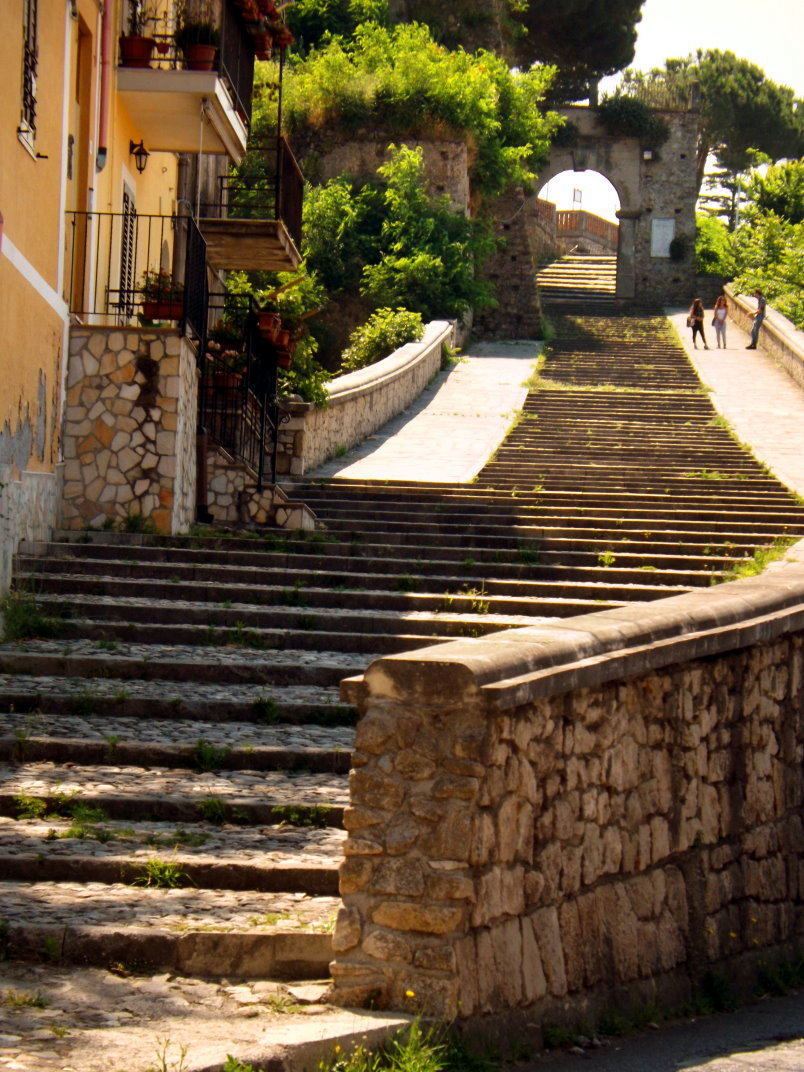
Paola train station is on the marina and a mere five minute walk to the beach and as in the rest of Calabria during the summer season you would be spoilt for choice of lido’s and beach bars. To reach the town itself takes a little longer and entails climbing what we have named ‘the thousand steps,’ a wide stairway which takes you up the cliff face into centro storico. We’ve never counted these steps and we know there probably aren’t a thousand, but on a hot summer’s day when climbing them it feels as if there are, note the ramps either side of the steps built originally for beasts of burden.

The 1000 steps

Being only a forty nine minute train journey from our home in Scalea our main day for visiting Paola is Sundays, as at the top of these steps is the start of the once weekly market which stretches up the side of the lower town and into the main piazza which is well equipped with bars and cafes to rest at after the arduous task of Italian market shopping. I have to say I am no fan of today’s clothing and household goods markets that are staged weekly in all Italian cities, as the larger percentage of the items are made in the people’s republic of China and can be purchased anywhere throughout Europe. Standing at six feet one and weighing over ninety kilos I am a giant compared to the average Calabrese, and as these markets stock only for the locals finding clothes in my own size becomes a problem, thankfully t-shirts bearing the Union Jack or the Stars and Stripes are not in my realm of fashion.
As the market winds up the streets we turn left at the first opportunity, this now takes you to the part of the market I have come for, ‘the food.’ Attracting marketers and local growers alike this part of the market supplies the very best of the areas fruit, vegetables and local produce. For those of you that prefer to avoid the clothes market and get straight to the fresh produce there is a convenient shady park walkway that follows up the back of the market stalls. Sadly I have to follow Kathryn through the clothes and ‘sparkly’ market but at times can still get a short respite by occasionally sneaking down the side of the stalls to this peaceful refuge.

The start of centro storico.
At the top of the hill you find yourself at the start of centro storico and like all the old towns a sightseeing meander through the streets is worth the effort, noting how Saint Francis plays a big part in the town’s churches, piazzas and artwork. Two slightly disappointing aspects of the town are the castle and ancient aqueduct. The castle like many down this coast stands proudly above the town but is slightly decaying and not accessible to the public, while the aqueduct has been shored up by ugly scaffolding for a number of years and its worth as a site to be photographed is marred by a high-rise apartment block built beside it.

The sanctuary of Saint Francis
A short distance out of the town is the Sanctuary of Saint Francis (1416-1507) which is the main reason many visitors and pilgrims come to Paola. Travelling by car down the main SS18 roadway the sanctuary is visibly signposted, and from the railway station it is a short taxi or bus ride.
The sanctuary which is still a working monastery is situated half way up a hill and is surrounded by beautiful well maintained gardens. A river of many waterfalls flows between and divides the sanctuary into two parts. Accessible by a bridge of two stories on the opposite bank the buildings are rooms and schools of the monks and are not open to the public.

The chapels and church on this side of the gorge tell their own story as you walk around the cloisters and down into the hermit cave and priest cell carved out of solid rock. Many of the miracles acclaimed to Saint Francis were carried out in the vicinity of the sanctuary, like the miracle of the falling rock, the miracle of the oven and that of the water spring brought forth by Saint Francis tapping a rock with his staff, all these sites are found as you walk around the area.

A more modern miracle acclaimed to the monastery was in August of 1943. Allied intelligence had information that Carlo Scorza who was born in Paola and was Mussolini’s second in command was there and the allies had ordered the bombing of the sanctuary. Like many of the monasteries in Italy local people had taken refuge in Paola’s, so when a 176 pound bomb fell amongst the assemblage and failed to detonate a miracle was the only explanation, the bomb is still displayed in the grounds today.
Behind the old buildings of the monastery a modern meeting hall has been built. No expense has been spared on this modern building with its highly polished wooden pews and stained glass ceiling a friend once likened it to walking into a kaleidoscope of coloured light.
The modern meeting hall.
If we can be of help on information on the towns of west Calabria please contact us at
 casa-cielo@hotmail.it
or via our facebook page
 https://www.facebook.com/casa.cielo
External links.

Vibo Valentia and Pizzo Calabro

P asseggiata at Pizzo Marina. Once our train trips south start to venture past Amantea from our home base of Scalea, making th...